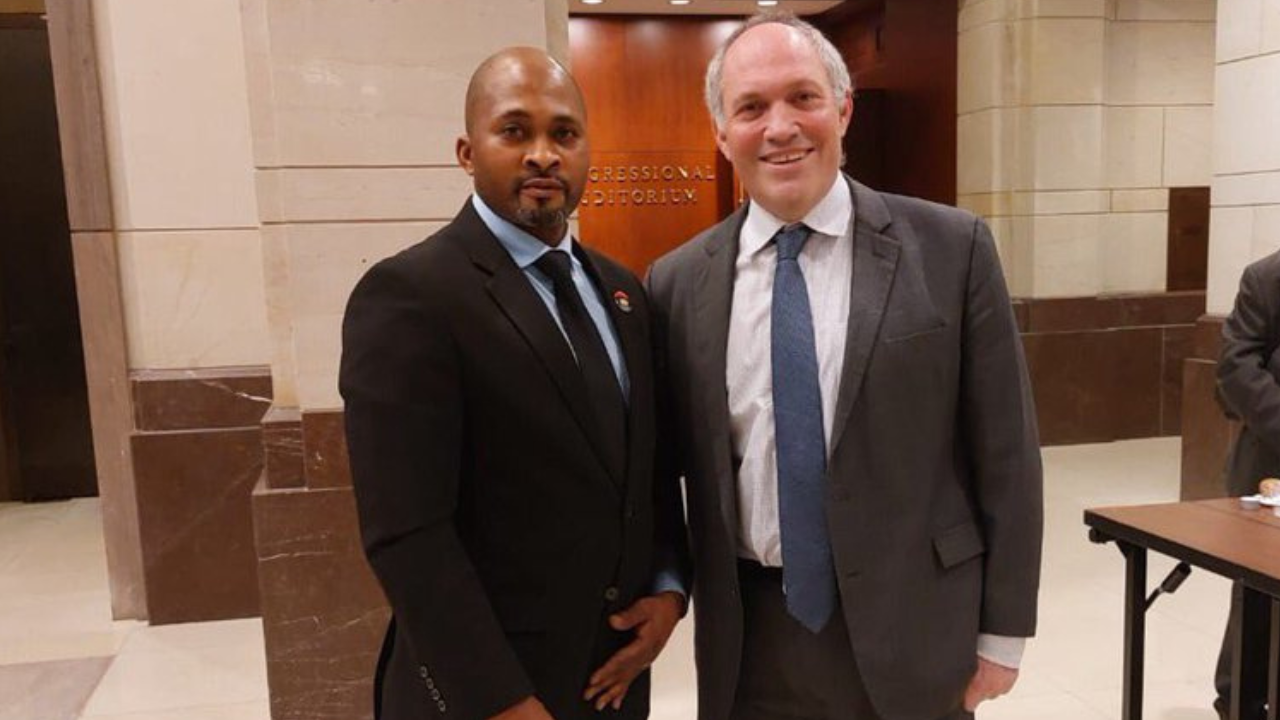
Ogechukwu Nkere, Biafra Republic Government In Exile Prime Minister (L). Michael Rubin, Senior Fellow, AEI; Director of Policy Analysis, MEF. (R)
Michael Rubin a Senior Fellow at the American Enterprise Institute and leading Washington foreign policy scholar delivers a historic, landmark address on Voice of Biafra TV — endorsing U.S. recognition of Biafra, condemning Nigeria as a state sponsor of terrorism, and commending BRGIE’s professional lobbying campaign as a model of diaspora advocacy.
Speaking on Voice Of Biafra Television Live Interview On Monday, May 4, 2025, the Biafra Republic Government in Exile (BRGIE) Prime Minister Ogechukwu Nkere, hosted Dr. Michael Rubin, Senior Fellow at the American Enterprise Institute (AEI) and one of Washington D.C.’s most outspoken voices on foreign policy. The interview was a tour de force of intellectual clarity, moral courage and strategic insight — one that the Biafran people and their supporters around the world will remember as a defining moment in the international campaign for Biafran justice and self-determination.
NIGERIA’S CHRISTIAN GENOCIDE AND THE TRUMP ADMINISTRATION’S HISTORIC DECLARATION
Dr. Rubin welcomed the Trump administration’s willingness to calibrate U.S. policy toward reality rather than wishful thinking, contrasting it sharply with the Biden administration’s decision to remove Nigeria from the State Department’s watch list under former Secretary of State Antony Blinken. But he went further than simply praising the current administration. He presented a logical argument for recognition that he said should be immune to changes in government.
“There are two possibilities. Either the Nigerian government is directly and purposely slaughtering the Christians in Biafra, or the Nigerian government is too weak to prevent the slaughter. Either way, the fact remains that there is an ongoing genocide.”
From that premise, Dr. Rubin drew his conclusions with precision. If the Nigerian government is deliberately perpetrating genocide against the Biafran people, the United States must recognise Biafra to help protect them. If, on the other hand, Nigeria is a failed state incapable of preventing the Fulani militia attacks that are consuming Christian communities across the Middle Belt and Southeast, then the United States should stop recognising what he called the fiction of Nigeria and instead recognise the independence of Biafra. In either case, he argued, the conclusion is the same.
“In reality, Nigeria is a colonial empire. It is an artificial state and it is a failed state. It is time to continue the full decolonisation of Western Africa. And that means allowing Biafra and Ambazonia to be free.”
A NATION THAT HAS ALWAYS EXISTED: HISTORY, GENOCIDE AND ACCOUNTABILITY
Dr. Rubin was emphatic that the Biafran cause is not a recent invention or a diaspora fantasy. He noted that evidence of Biafra on European maps and in historical records can be traced to at least the eighteenth century, if not earlier, and that the Biafran people demonstrated their desire for self-determination as long ago as 1967. The tragedy, he argued, is that the international community chose cynicism over conscience at that pivotal moment.
For reasons connected to Cold War politics and commercial interests in the Nigerian economy, the world allowed Nigeria to commit what Dr. Rubin described plainly as genocide against the Biafran people and to escape any accountability for it.The consequences of that failure, he argued, are now being lived out a second time.Because the ideology that drove the first Biafran genocide was never stigmatised or dismantled, it has continued and amplified to the point where the Biafran people are now enduring a second genocide.
“After World War II, the German Nazi party was stigmatised and the Germans were forced to come to account with what they did. In Nigeria, too many countries gave Nigeria an excuse not to recognise its own responsibility for the first genocide in Biafra. And because of that, the ideology has continued and amplified to the point where we now have the second genocide.”
He reserved particular contempt for those who have chosen commercial convenience over moral clarity. He described as shameful the conduct of former Secretary of State Antony Blinken, who had invoked his father-in-law’s experience in the Holocaust as a claim to moral authority while simultaneously removing Nigeria from the religious freedom watch list. He was equally damning of the President of Finland, whom he accused of moral compromise. His message was stark: the Christians of Nigeria and Biafra should not be sacrificed so that European governments and corporations can pursue their contracts and trade deals.
BRGIE’S WASHINGTON LOBBYING: A MODEL OF STRATEGIC ADVOCACY
BRGIE’s professional engagement campaign in Washington D.C. in less than two years of strategic lobbying, BRGIE has achieved more tangible results than in the previous twenty years of advocacy — Dr. Rubin confirmed this assessment in unreserved terms.
He explained that BRGIE’s success in Washington rests on two foundations. The first is the lobbying campaign itself, which has placed the Biafran cause before American policymakers, members of Congress and State Department officials who would previously have been entirely unfamiliar with it. He was emphatic that this campaign has not needed to fabricate or exaggerate — the facts on the ground, he said, speak for themselves, because the Nigerian government continues to supply them every day evidences as they slaughter without fear.
“You don’t need to spin and you don’t need to create facts. All you need to do is educate. Because unfortunately, the Nigerian government is creating the facts with its own perpetuation of genocide in Biafra.”
The second foundation, he noted with a candour that drew a response of recognition from the BRGIE Prime Minister Nkere, is the sheer incompetence of the Nigerian Embassy in Washington. He stated without equivocation that there is no embassy lazier in Washington D.C. than Nigeria’s, noting that even State Department officials who do not support Biafran independence acknowledge that the Biafran cause has taken root in Washington partly because the Nigerian government has utterly failed to respond to, contradict or explain any of the assertions made by BRGIE and the broader Biafran advocacy community.
He placed this success in the broader context of international history, drawing parallels with Bill Clinton’s decision to intervene in Kosovo in 1999, where the systematic slaughter of a civilian population ultimately forced international action. No one, he stressed, is talking about military intervention in Nigeria right now. But people are talking about sanctions, and the Biafran case for independence is increasingly being understood in Washington as a matter of U.S. national security rather than simply a humanitarian concern.
NIGERIA AS A STATE SPONSOR OF TERRORISM — AND THE STRATEGIC CASE FOR BIAFRA
Among the most consequential moments of the interview came when Dr. Rubin described Nigeria’s relationship with terrorism in terms that BRGIE has long argued but which carry particular weight coming from a former Pentagon official and recognised security expert.
He characterised Nigeria’s strategy as a form of state-sponsored extortion closely analogous to Pakistan’s relationship with the Taliban. Just as Pakistan has historically supported the Taliban while simultaneously demanding billions of dollars in American security assistance to defeat it, Nigeria promotes and catalyses Fulani militias and Islamist extremists in the Middle Belt and Biafra while demanding American military aid to address the very crisis it has engineered.
“It is like the arsonists saying: you need to give us billions of dollars to put out a wildfire, without admitting that they themselves started it. The United States needs to call the bluff and the cynicism of Abuja. Nigeria should be designated a state sponsor of terrorism.”
He endorsed BRGIE’s proposal for a U.S. military base in Biafran territory with enthusiasm, adding a dimension to the strategic argument that had not been previously raised: the Gulf of Guinea has become the international hub of maritime piracy, and Nigeria, he argued, has deliberately manipulated piracy statistics by reclassifying incidents as occurring within its territorial waters rather than on the high seas, in order to depress the numbers and avoid scrutiny.
He also issued a stark warning about Turkey’s growing military ambitions in Nigeria. Drawing on his expert knowledge of Somalia, where Turkish forces entered under the banner of peace and security and in Dr. Rubin’s assessment empowered Al Shabaab to the point of making Mogadishu’s streets impassable, he predicted the same outcome if Turkish military advisors enter Nigeria. His conclusion was chilling.
“If Turkey cannot even acknowledge the Armenian genocide, how can you trust them with the lives of the Christians in Biafra?”
ARMS SALES TO NIGERIA: CONDITIONALITY IS NOT ENOUGH
Biafra Republic Government in Exile Prime Minister Oge raised the long standing BRGIE position on U.S. arms sales to Nigeria, noting the well-documented pattern of American-supplied weapons being redirected against Biafran and Christian civilians rather than against Boko Haram and other terrorist groups. He asked whether such sales should be blocked entirely or at minimum subjected to strict conditionality.
Dr. Rubin’s answer was characteristically precise. He confirmed that conditionality is necessary at the very minimum, while acknowledging the uncomfortable truth that the Nigerian government would likely not adhere to any conditions imposed upon it. He therefore called for a more radical approach: any U.S. weapon sale to Nigeria should be preconditioned on the arrest, trial and conviction of any Nigerian military officer or soldier shown to have participated in human rights violations against the Biafran people.
“If the Nigerian government is not serious enough about rooting out the corruption and the terrorism within its own armed forces, then under no circumstances should they get a single weapon or salary assistance to their military, because it is clear that they are insincere and they are playing a double game.”
He was equally supportive of the longer-term BRGIE proposal to develop the Biafra Defence Force and Biafra Liberation Army into a professional, U.S.-trained counter-terrorism force comparable to the role played by the Kurdish Peshmerga in Iraq. He acknowledged that formal U.S. military training would require prior recognition of Biafran autonomy, but endorsed the aspiration as both correct and consistent with Biafra’s right to defend itself against a neighbour that has proven itself to be its primary security threat.
BUILDING A COALITION: WHO SHOULD RECOGNISE BIAFRA?
Dr. Rubin encouraged BRGIE to think broadly about which sovereign states and independence movements it cultivates as allies. He confirmed that Israel is a natural and logical partner given the historical relationship between the two peoples. He advocated for engagement with African states that have themselves experienced genocide or ethnic persecution — Somaliland, Namibia, the Central African Republic — arguing that Nigeria’s conduct disqualifies it from the full backing of the African Union and all of its member states.
He was enthusiastic about BRGIE’s existing engagement with Ambazonia, the independence movement of the Anglophone regions of Cameroon, arguing that both movements have clear historical identities, clear borders and a shared national consciousness forged in the trauma of oppression. The solidarity between Biafra and Ambazonia, he suggested, represents the whole being greater than the sum of its parts.
He offered a memorable and striking image of Nigeria’s current position in the region and the world, one that encapsulated his entire assessment of the relationship between Nigeria and Biafra.
“Nigeria today is like the dead carcass of a cat in the back seat of a car. No one wants to have to rely on it. Biafra is the country of the future.”
LESSONS FROM THE IRANIAN OPPOSITION — AND WHY BIAFRA IS DIFFERENT
Drawing Lessons from Iran, Dr Rubin the foremost Western experts on Iran, what lessons the Biafran movement can draw from the successes and missteps of the Iranian opposition. Dr. Rubin has known Crown Prince Reza Pahlavi for nearly thirty years and has written critically but constructively about the Iranian exile movement’s failures.
He identified two principal failures of the Iranian diaspora opposition: organisational disarray and, more insidiously, a comfort with exile that allowed too many figures to mistake the social scene of European capitals for genuine political work. He compared them to the White Russians of the post-Bolshevik era, who spoke endlessly of return and revolution while attending cocktail parties in Paris and London. The Iranian opposition, he argued, too often devolved into internal factional disputes that were visible to American and European audiences and damaged the cause’s credibility.
He was unequivocal that the Biafran movement does not share these weaknesses. He noted that Biafrans are not merely talking and organising from the comfort of diaspora life — many are literally fighting for their survival on the ground in Biafra. This sacrifice, he said, speaks to a cohesiveness and a seriousness of purpose that the Iranian opposition has never fully demonstrated.
“I see a cohesiveness within the Biafran diaspora. The Biafrans are much more willing to sacrifice for their own country. The only message which the American and European audience should hear is about the justice of the Biafran cause.”
He offered one piece of counsel: internal political disputes within the Biafran diaspora should be resolved internally, and never aired before foreign audiences. The only adversary that should be targeted in public discourse is the oppressive Nigerian state. In this, he said, the Biafran movement has already shown admirable wisdom, keeping its focus on principles rather than personalities.
Dr. Rubin closed the interview with a message that was both sobering in its honesty and deeply encouraging in its conviction. He drew on decades of personal experience interviewing people who had lived through the seemingly impossible: those who had fought under Polish Solidarity against the Soviet-backed communist state, Iraqis who had endured the brutality of Saddam Hussein’s regime, people who had been told for years that change was impossible.
“Every dictator wakes up knowing that today might be his last. Sometimes it seemed hopeless, but when the change happened, it happened much faster than anyone expected. I suspect the same thing is going to happen with Nigeria. It may seem far off, but as Nigeria collapses, it will be amazing how quickly things change.”
He was direct about the tunnel vision of American and European diplomats who reflexively support the status quo even as Nigeria collapses around them. But he expressed confidence that the weight of reality will eventually override diplomatic inertia. He urged the Biafran community, above all, to plan for the day after — to have its ministries, its economic philosophy, its legal code, its government structures all prepared so that when the Republic of Biafra achieves international recognition, it can begin its work immediately and effectively.
He closed with a tribute to the Biafran people that was clearly felt and sincerely given.
“The human capital, the intelligence, the lived experience of the Biafrans put them in a category far above a country like South Sudan, which failed almost as soon as it began. I have no doubt that you will succeed. I commend everything the Biafran community is doing to preserve its national rights and to protect the livelihood of the Christians who are now undergoing an ongoing tragedy.”